September 2026
A big thank you to everyone who has volunteered for Bike Scottsdale committees and donated funds to Bike Scottsdale - we are so grateful for your support! If you would like to lend a hand - please reach out to [email protected].
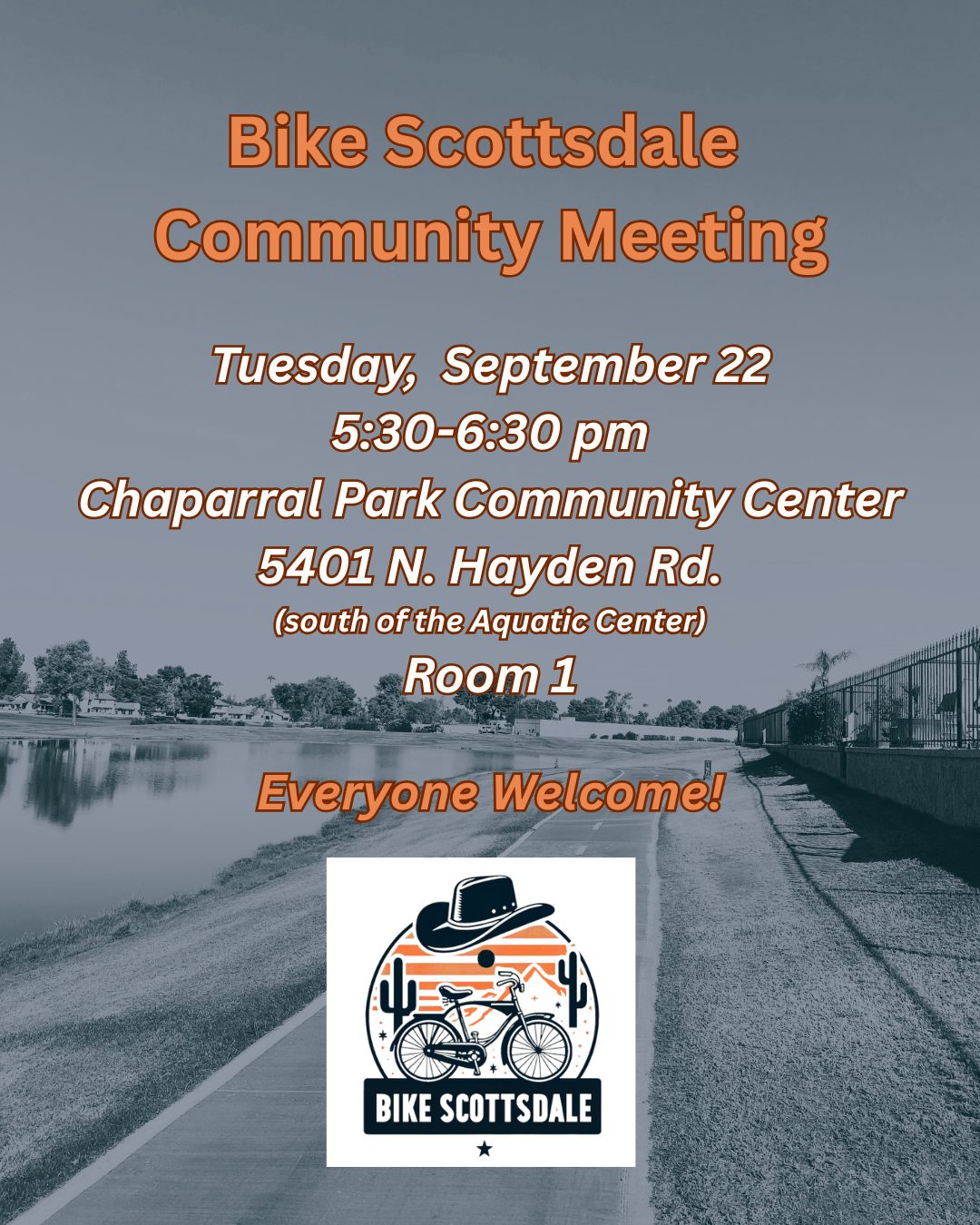
Please join us next week! Our upcoming community meeting will be held on Tuesday, September 22 at 5:30 pm at Chaparral Park Community Center. See details below. We will have a guest speaker from the City discuss the new Pedestrian Safety Zones and eBikes in our community. We also plan to discuss upcoming priorities for our organization.
Scottsdale Traffic Report Reveals Key Bicycle Safety Trends
by Natalie Chrisman Lazarr
New data from the recently published 2024 Traffic Volume and Collision Report for the City of Scottsdale highlights both progress and ongoing challenges for people who bike in the West’s Most Western Town. While bicyclists remain involved in a relatively small percentage of overall crashes, the report underscores the importance of continued investments in safer streets, targeted safety improvements, and rider awareness.
Crashes Involving Bicyclists Represent Just Over 2% of Reported Collisions
According to Scottsdale's analysis of traffic collisions occurring on major roadways and intersections during 2023 and 2024, a total of 7,341 crashes were recorded. Of those, 150 involved bicyclists, representing approximately 2.0% of all reported collisions on the city's major transportation network. While bicycle crashes make up a relatively small share of total collisions, the consequences can be severe because cyclists lack the physical protection afforded to motor vehicle occupants. The report documented three fatal bicycle collisions during the two-year study period.
Where and How Bicycle Crashes Occur
The report's bicycle collision analysis shows that angle collisions are by far the most common type of bicycle crash, accounting for 47.3% of incidents. Left-turn collisions represent another 14.0%, while rear-end crashes account for 6.7%. Smaller percentages include sideswipe, head-on, and single-vehicle bicycle crashes. These findings suggest that intersection conflicts remain one of the most significant risks for cyclists. Drivers turning across a cyclist's path or failing to properly yield continue to create conditions where angle and turning collisions occur.
Most Bicycle Crashes Result in Injury
Unlike automobile crashes, where the majority result in no reported injury, bicycle crashes frequently lead to physical harm. The city's data show:
- 57.3% of bicycle crashes resulted in non-incapacitating injuries.
- 12.7% resulted in incapacitating injuries.
- 16.0% resulted in possible injuries.
- 10.7% resulted in no injury.
- 2.0% resulted in a fatal injury.
For cyclists, this means nearly nine out of ten reported bicycle crashes resulted in some level of injury.
Safety Improvements Are Becoming More Data-Driven
One of the most significant updates in Scottsdale's 2024 report is the addition of fatal and serious injury (KSI) collision analysis. Locations throughout the city are now ranked not only by collision frequency and collision rate, but also by the number and rate of crashes resulting in death or serious injury. Transportation staff use the report to:
- Identify high-risk intersections and road segments.
- Prioritize locations for Road Safety Assessments (RSAs)
- Support capital improvement project decisions.
- Track collision trends over time.
- Compare specific corridors against citywide averages.
A Mixed Safety Picture
Overall roadway segment collision rates improved between 2022 and 2024, decreasing by 5.1%. However, intersection collision rates increased by 10.1% during the same period. Since many bicycle crashes occur at intersections, that trend highlights an area deserving continued attention from planners, engineers, advocates, and road users alike. Cyclists can reduce risk by increasing visibility, anticipating turning vehicles, making eye contact with drivers when possible, and exercising additional caution at busy arterial crossings.
At the same time, Scottsdale's expanding use of collision analytics and serious injury tracking provides a stronger foundation for identifying problem locations and targeting future safety investments. For the local cycling community, that means better data to support safer infrastructure and more informed discussions about where improvements are needed most.
Scottsdale Streets: Why Local Action Matters in the Face of Federal Bike Lane Cuts
by Natalie Chrisman Lazarr
The national landscape for bicycle infrastructure has shifted dramatically. The Department of Transportation (DOT) has frozen and redirected $1.73 billion in federal infrastructure grants away from walking and cycling projects. Under a new policy direction, federal officials have labeled multimodal projects as “DEI bike lanes,” actively scrubbing safety data and references to bicycle planning from the Federal Highway Administration (FHWA) websites. Bike lanes have even been stripped from the federal list of "Proven Safety Countermeasures," despite non-motorized users accounting for over 20% of traffic deaths nationwide. While the federal government pivots funding back toward traditional car-only highway expansions, the true fight for safer streets is happening right here in Scottsdale.
What’s Happening on the Ground in Scottsdale
Scottsdale is recognized as a Gold-Level Bicycle Friendly Community, but maintaining that standard requires constant local vigilance. Federal policy changes mean we may no longer rely on federal grants to close critical infrastructure gaps.
Major multimodal developments are already underway, and they need our public support to stay on track. Here are just a few:
- The Scottsdale Road Complete Street Project: Crews are currently active on North Scottsdale Road (from Jomax Road to Dixileta Drive), converting it into a complete street with dedicated bike lanes, shared-use paths, and landscaped medians. This project has already faced shifting timelines due to City Council re-designs (on April 8, City Council directed staff to change the planned roundabout at Scottsdale Road and Dynamite Boulevard to a traditional signalized intersection). It is critical that we keep the pressure on city leaders to finish this corridor and prioritize multimodal safety.
- Pima Road Multi-Use Path Detours: Active widening and multi-use path construction continue on Pima Road (McDowell Road to Indian Bend Road). Local riders must stay engaged to ensure that when these detours conclude, the final returned infrastructure prioritizes world-class rider safety.
- Protecting the Network: Previous successes, like the completed 68th Street Bike Lanes, prove that local advocacy works to bridge connectivity gaps to downtown. We must keep pushing the city to fulfill its Bikeway Element in the Transportation Plan by completing and renovating our primary shared use paths, ensuring other paths and bike lanes prioritize connectivity and neighborhoods are supported with safe and maintained bikeways. Every child should be able to safely ride their bike to their neighborhood school.
How to Get Involved
- Attend Scottsdale City Council Meetings/Participate in City Government: Local municipal choices dictate where our streets are paved and striped. Show up to council meetings or submit public comments advocating for the continuation of "Complete Streets" funding. Apply to represent your community on the Scottsdale Transportation Commission and/or attend commission meetings to learn more about local transportation issues.
- Reframe the Message: When speaking with your community and city representatives, remind them that bike infrastructure isn't partisan—it is a standard engineering tool that increases our quality of life. Bike lanes lower traffic speeds, protect neighborhood children, support Scottsdale's booming bicycle tourism economy, and keep our residents safe.
- Organize Globally, Ride Locally: Plug into regional networks like Bike Scottsdale or state coalitions to participate in community data-mapping, identify dangerous intersections, and amplify the demand for physical protection on high-speed arterials.
The federal government may be rolling back resources, but Scottsdale's streets belong to everyone - inclusive of the people who walk, run, and pedal them every day. Let's keep moving forward.
Upcoming regional cycling events
- Mt. Graham Hill Climb (Safford) - September 20, 2026
- Mesa Sprint Triathlon (Mesa) - September 26, 2026
- Sonoran Shred Mountain Bike Race (Vail) - September 26, 2026
- Tour of the White Mountains Mountain/Gravel Ride/Race (Pinetop-Lakeside) - October 3, 2026
- Castle Creek Triathlon (Lake Pleasant) - October 3, 2026
- Chino Grinder Gravel Race (Chino Valley) - October 17, 2026
- Cycle Arizona 66 (Kingman) - October 17, 2026
- Trick or Tri Triathlon (Florence) - October 31, 2026
- Sun Devil Triathlon Classic (Tempe) - November 8, 2026
- Bike MS Road and Mountain Ride (Fountain Hills) - November 7-8, 2026
- Cave Creek Cactus Classic Mountain Bike Race (Cave Creek) - November 14, 2026
- 6 & 12 Hours of Fury Mountain Bike Race (Fountain Hills) - November 21, 2026
- El Tour de Tucson Road Ride (Tucson) - November 21, 2026
- Estrella Cup Mountain Bike Race (Goodyear) - December 6, 2026
- Holiday Classic Triathlon (Anthem) - December 12, 2026
Do you want to add a race or event to this list? Please contact [email protected].